Plankton Sampling

What are plankton?

Plankton, a word loosely meaning, "to drift", are distributed throughout the lake. They are found at all depths and are comprised of both plant (phytoplankton) and animal (zooplankton) forms. Plankton show a distribution pattern that can be associated with the time of day and seasons.

There are three fundamental sizes of plankton: nannoplankton, microplankton, and macroplankton. The smallest are nannoplankton that range in size from 5 to 60 microns (millionths of a meter). Because of their small size, most nannoplankton will pass through the pores of a standard sampling net. Special fine mesh nets can be used to capture larger nannoplankton.

Most planktonic organisms fall into the microplankton or net plankton category. The sizes range from the largest nannoplankton to about 2 mm (thousandths of a meter). Nets of various sizes and shapes are used to collect microplankton. The nets collect the organisms by filtering water through fine meshed cloth. The plankton nets on the vessels are used to collect microplankton.

The third group of plankton, as associated with size, are called macroplankton. They are visible to the unaided eye. The largest can be several meters long.

How are plankton sampled?

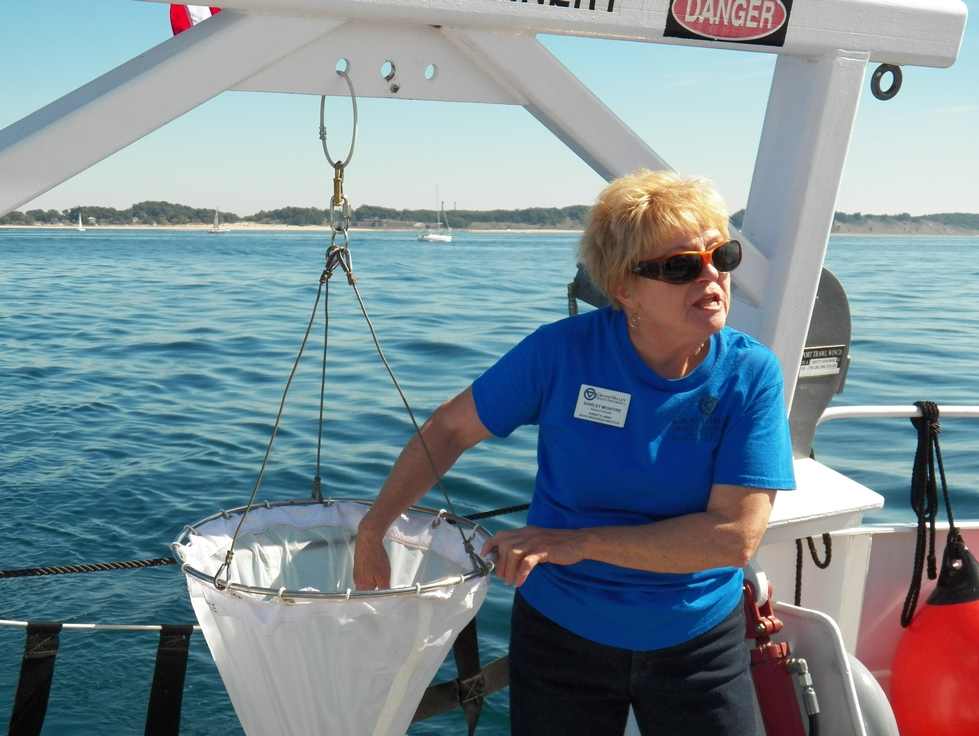
using plankton netThe plankton net or sampler is a device that makes it possible to collect both phytoplankton and zooplankton samples. For quantitative comparisons of different samples, some nets have a flow meter used to determine the amount of water passing through the collecting net.

The plankton net or sampler provides a means of obtaining samples of plankton from various depths so that distribution patterns can be studied. Quantitative determinations can be made by considering the depth of the water column that is sampled. The net can be towed to sample plankton at a single depth (horizontal tow) or lowered down into the water to sample the water column (vertical tow). Another possibility is oblique tows where the net is lowered to a predetermined depth and raised at a constant rate as the vessel moves forward. The plankton net is stored inside the cabin on the port side (left) under the countertop. At the beginning of each cruise, the crew will place it out on deck.

What is commonly found in plankton samples?

The base of the food chain for Lake Michigan is plankton. The phytoplankton are the producers and they are typically green algae, blue green algae, and diatoms. Crustaceans such as water fleas (Daphnia), cyclops, and copepods are representatives of the consumers or zooplankton found in samples. Examples of species collected in plankton tows can be found in the plankton data sheet and the drawings in Appendix D.

Instructions for use of a plankton net:

NOTE: The plankton sampler is attached to and retrieved from the hydrographic wire (winch line) by the deckhand. A person will be assigned to work on the hero platform to help the deckhand secure and remove the sampler from the wire.

  1. The deckhand will ask one of the people assigned to assist him/her to bring the plankton net to the "hero platform".
  2. One person, wearing a Personal Flotation Device (life jacket), will stand on the "hero platform" and assist the deckhand in attaching the plankton net to the winch line. The apparatus is examined to make certain that all the parts are in place. The plankton net is lowered into the water to a depth that is equal to about 2.7 times the Secchi disk depth as measured at that sampling station.
  3. The deckhand then retrieves the net and brings it on-board. The net is kept in a vertical position to avoid losing any of the plankton sample. Water is sprayed down through the net toward the sample container. This is done on all sides of the net to insure removal of any sample caught in the net. The water will flush the sample into the bottom sample container.
  4. The clamp holding the net to the sample container is loosened, and the container is removed from the net. The sample is then transferred from the container into a beaker for transport into the main cabin. The beaker is placed in the sink in case it spills. Samples are taken from the beaker for viewing and counting under a microscope equipped with a video camera and monitor.
  5. Additional water is sprayed onto the entire plankton sampler to clean it. The sample container is rinsed in clean water and then re-attached to the net. The sampler is then returned to its place on the deck.

<< previous page      next page >>

  Last Modified Date: February 9, 2009
Copyright © 1995 - 2009 Grand Valley State University is an Equal Opportunity/Affirmative Action Institution